By Lan Zou, SA WG5 Chair (Huawei), Zhulia Ayani, SA WG5 Vice Chair (Ericsson), Zhaoning Wang, SA WG5 Vice Chair (China Unicom)
Published December 2025, in Highlights Issue 11
Management and Orchestration standards include requirements, management stage 2, management procedures, stage 3 RESTFUL OpenAPI and NETCONF/YANG solution sets to provide complete interoperability capabilities for operators to manage 5G networks in a multi-vendor environment. The purpose of this article is to provide a summary introduction to the related management features.
5G Management and Orchestration Use cases
With more and more new 5G network and service features, operators need to manage network features with multi-vendors’ products in a consistent manner and make sure the network and service are stable as much as possible. To manage network in a more efficient way, there are two aspects addressed in standards:
Managing new 5G network elements and new network functions for:
- Network slicing (Provisioning, Network Resource Model, performance Assurance, fault supervision, tenancy concept etc.)
- Non-public networks (NPN fault management, SLA monitoring and assurance, resource management for NPN, NPN access control, etc.)
- 5G network sharing (Management support for MOCN and INS scenarios, performance and configuration management in PLMN granularity, management capabilities and architecture based on SBMA, access control for POPs, etc.)
- Non-terrestrial networks (management capability and architecture support for NTN, transparent mode feature management, Backhaul feature management, regenerative mode feature management, UE-Satellite-UE communication feature management, etc)
- Ambient IoT (gNB reader served A-IoT areas management, reader location management, index for A-IoT capable gNB/reader selection management, etc.)
- 5GC features (5GC NF management, NWDAF management, 5GLAN management, edge computing management, XRM Service management, )
- RAN features (NG-RAN management, MR-DC management, URLLC management, RedCap service management, IAB-node management, WAB-gNB management, NR Femto management, )
Managing and orchestrating intelligence and automation cases including:
- Management analytics (Coverage related analytics, SLS analysis, MDA assisted fault management, MDA assisted Energy Saving, MDA assisted mobility management, MDA assisted critical maintenance management, Resource related analytics, Prediction and statistics of Management data, Correlation analytics of Management data, Traffic Steering Analytics etc.)
- 5G Self-organizing networks (RACH optimization, Mobility Robustness Optimisation, PCI configuration, ANR management, LBO (Load Balancing Optimisation) management, MRO for Conditional Handover (CHO) management, MRO for DAPS (Dual Active Protocol Stack) handover management, MRO for Lower-layer Triggered Mobility (LTM) management, RRM resources optimization for network slice instance(s) management, Centralized Capacity and Coverage Optimization management, LBO (Load Balancing Optimisation) management etc.)
- Intent-driven management (delivering radio network, delivering a radio service, delivering a service at the edge, assuring coverage performance, assuring radio network performance, end-to-end network optimization intent, RAN energy saving intent, 5GC network intent, network maintenance intent etc.)
- Energy efficiency management (Data Volume (DV) collection, Power, Energy and Environmental (PEE) measurement collection, ES - Capacity booster cell partially overlaid by candidate cell(s), ES - Capacity booster cell fully overlaid by candidate cell(s), Energy saving optimization for multi-carrier RAN scenarios with several partially or fully overlaid capacity booster cells, Energy Efficiency as a Service Criteria etc.)
- AI/ML management (ML model training, ML model testing, AI/ML inference emulation, ML model deployment, AI/ML inference etc.)
- Network digital twins (Control and life cycle management of NDTs, NDT support for network automation, NDT support for verification, NDT support for data generation, Collaboration between NDTs etc.)
5G Service Based Management Architecture
5G management and orchestration adopts Service Based Management Architecture (SBMA). The fundamental building block of the SBMA is the Management Service (MnS). An MnS is a set of offered capabilities for management and orchestration of network and services. An MnS producer offers its MnS to MnS consumer via a standardized service interface composed of individually specified MnS components.
The flexibility of SBMA allows the 3GPP management and orchestration specifications to be used for different deployment scenarios wherever applies. The following diagram illustrates an architecture reference model for management and orchestration, also shows how the management architecture is integrated with the network architecture. The functions in the management domain are logical, implementation-agnostic entities, defined independently of any specific deployment scenario. More details could be found in 3GPP TS 28.533.
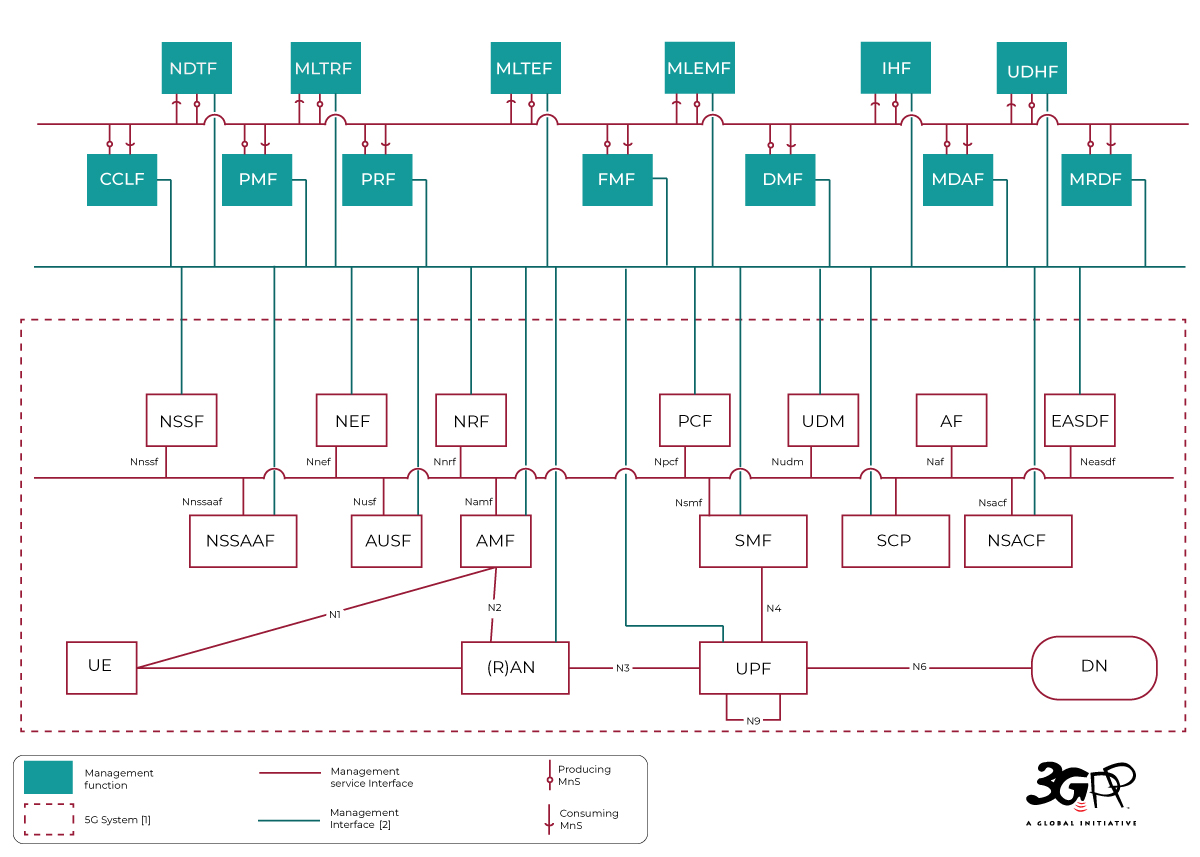
Figure 1: Illustrative architecture reference model for management and orchestration
SA WG5 5G Management and Orchestration functional features
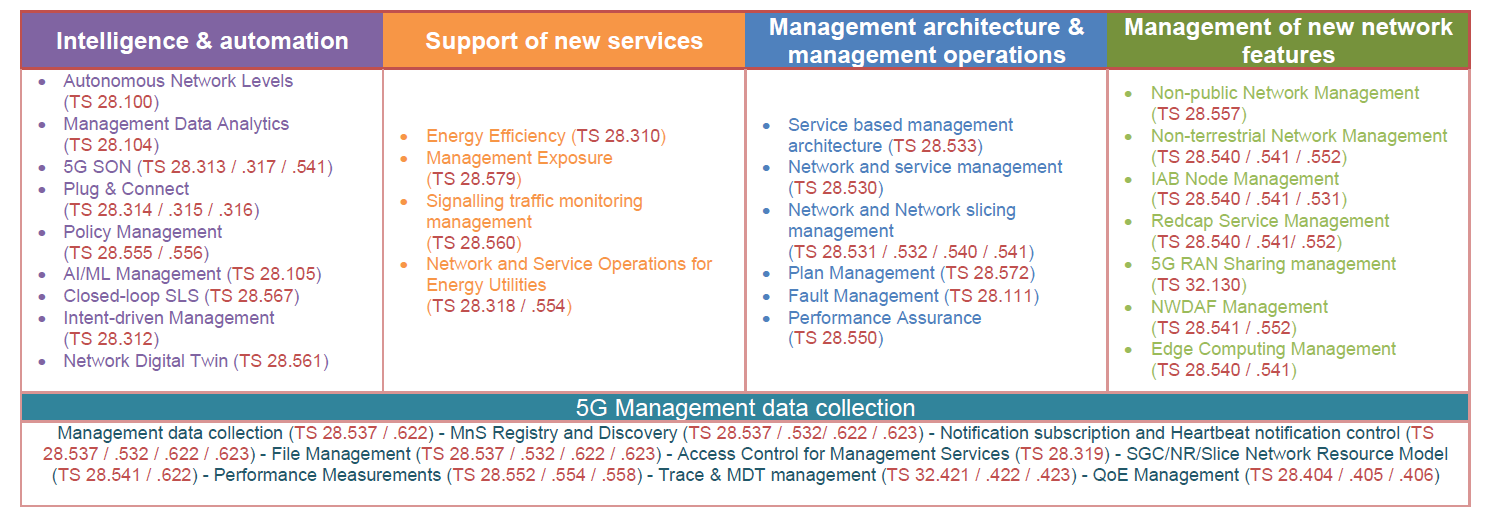
The following functional areas in SA5 cover management and orchestration features. They provide complete management and orchestration functionalities for 5G, improve efficiency in management and orchestration, support operators in managing end to end services, both for basic and new network features.
Intelligence and automation: By utilizing new advanced technologies like AI/ML, intent, NDT, closed control loop, operators get the advantage of improving the operational efficiency in their complex networks. In addition, standard also provides various mechanisms for operators to monitor and manage the intelligence and automation features and make sure the features run properly according to operators’ expectation and are fully under operators’ control.
Support of new services: end to end solution from network to new service needs close collaboration and clear division of responsibilities from multiple players. Standardized solutions could help the players to find appropriate roles, engage domain expert knowledge, setup the work collaboration boundaries and jointly contribute to the service growth.
Management operations / Managing of new network features: generic standardized management operations together with the corresponding network features are specified to manage subnetworks, network elements and network functions, with this approach, operators could keep consistent management behavior for 5G network.
Management data collection: to support operators’ management and orchestration purpose, various types of data could be collected via standardized mechanisms across multi-vendor environment.
SA5 5G management services exposure
There are various ways of management exposure depends on different operators’ deployment needs. Management service can be exposed to internal MnS consumers (i.e. MnS consumers within the PLMN trust domain) and external MnS consumers (i.e. MnS consumers outside the PLMN trust domain). These consumers can be classified into the following categories:
- Internal MnS consumer X1: MnS consumer within the 3GPP management system, e.g. provisioning MnS consumer, fault management MnS consumer and streaming MnS consumer.
- Internal MnS consumer X2: MnS consumer outside the 3GPP management system but within the PLMN trust domain, e.g. NWDAF, operator’s AFs, Edge Application Server.
- External MnS consumer Y1: MnS consumers outside the PLMN trust domain consuming management services directly from the 3GPP management system, e.g., participating operators in RAN sharing scenarios, energy utility verticals, and other verticals.
- External MnS consumer Y2: MnS consumers outside the PLMN trust domain consuming management services through CAPIF framework (3GPP TS 23.222), e.g. energy utility verticals, and other verticals.
The exposure of management services to the different types of MnS consumers includes two functional aspects: discovery of the MnSs and access control. As a precondition, the discovery of management services assumes that the management services to be exposed have been registered.
Figure 2 illustrates different exposure scenarios, depending on the type of MnS consumer. For MnS consumers X1, X2 and Y1, registered management services are exposed using the mechanisms that 3GPP management system already defines for MnS, discovery and access control in TS 28.537 [2] and TS 28.533 [1]. For MnS consumer Y2, registered management services are exposed using the CAPIF framework, using the mechanisms defined in 3GPP TS 28.579 [3].
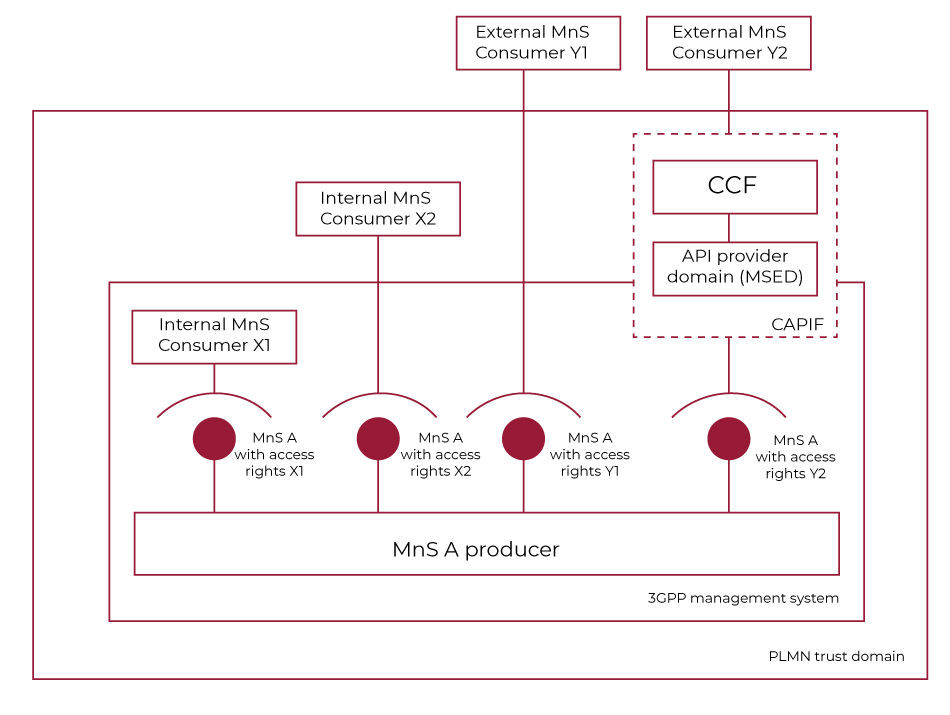
Figure 2: Management services exposure scenarios
SA5 Management and Orchestration Stage 3 solutions
The standardized stage 3 solutions provide two alternative solution sets: RESTFUL and NETCONF/YANG. Operators could select different solution set for integration according to different business needs. The table below shows the management and orchestration features and their corresponding management capabilities. More information regarding Management and Orchestration APIs could be found in TS 28.533 [1] or access 3GPP forge website: https://forge.3gpp.org/rep/sa5/MnS
| Management Feature | Management Capability |
| Network and network slicing management | NR Provisioning |
| 5GC Provisioning | |
| Network Slicing Provisioning | |
| Edge Computing Management | Edge Computing Provisioning |
| Performance Assurance | Performance Metric Collection Control |
| Performance Metric Data Report | |
| Performance Metric Threshold Monitor Control | |
| Performance Metric Threshold Notification | |
| Fault Management | Fault control |
| Fault Notification | |
| Trace and MDT management | Trace/MDT data collection control |
| Trace/MDT data report | |
| Signalling traffic monitoring management | STM provisioning |
| STM streaming | |
| QoE management | QoE data collection control |
| QoE data report | |
| File Management | File Retrieval |
| File Download | |
| Plan management | Configuration plan management |
| Notification subscription and Heartbeat notification control | Subscription Control |
| Heartbeat Control | |
| Heartbeat Notification | |
| MDA | Management Data Analytic |
| SON | RANSC Management |
| SON policy | |
| Closed-loop | Communication Service Assurance Control |
| Closed control loop management | |
| Intent driven management | Intent Driven Management |
| AI/ML management | ML model Management |
| NDT management | NDT Lifecycle Management |
| MnS Registry and Discovery | MnS Registry and Discovery |
| MgmtData Registry and Discovery | |
| MSAC | MnS Access Control |
| NSOEU | DSO Rapid Recovery and Threshold Monitoring |
| External Data Management | External Data Discovery and Request |
Summary
SA WG5 management and orchestration takes an important role in the network and service ecosystem and it provides the integrated view in 3GPP including both the network and the management of the network and service. SA5 SBMA standard and interfaces would help operator using generic management framework for multi-vendors integration and could accommodate various deployment scenarios. With introduction of intelligence and automation features, operators could best utilize the new technologies and improve operational efficiency, and build good basis to provide new agile services to their customers.
References
[1] TS 28.533 Management and orchestration; Architecture framework
[2] TS 28.537 Management and orchestration; Management capabilities
[3] TS 28.579 Management and orchestration; Management services exposure to external consumers through CAPIF
For more on WG SA5 go to the groups webpage.
 Technology