This article is based on material from TCCA’s white paper IWF - Interworking of LMR networks with 3GPP Mission Critical Services. Lead author: Sylvain Allard, Capgemini.
Published December 2025, in Highlights Issue 11
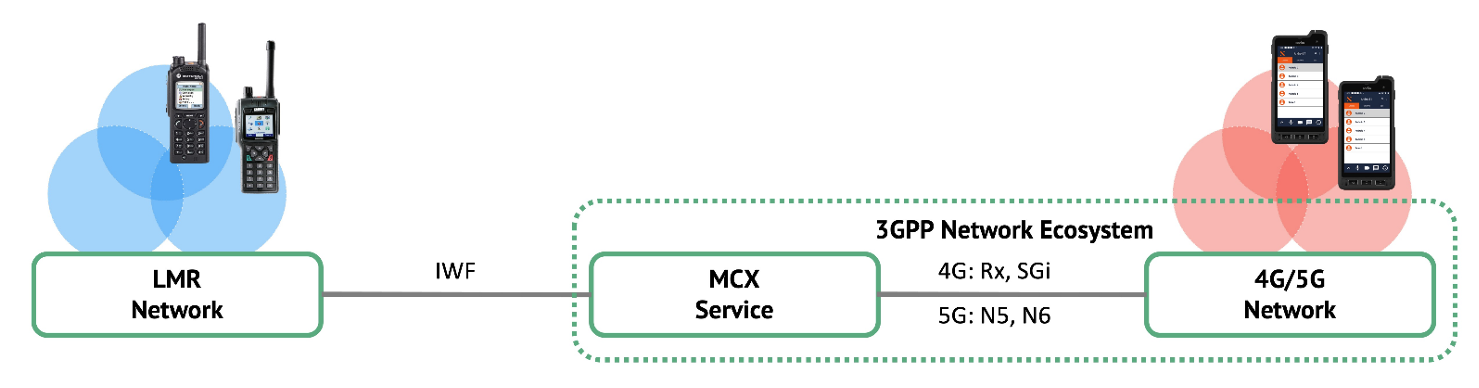
The Interworking Function (IWF) is a function defined by 3GPP to enable seamless communication between next-generation Mission Critical Services (MCX)—delivered over LTE and/or 5G broadband networks—and legacy narrowband technologies such as TETRA, APCO P25, and GSM-R.
As public safety agencies, transport operators, and critical infrastructure providers embark on the migration from traditional Land Mobile Radio (LMR) systems to broadband MCX platforms, the IWF stands out as a key enabler for interoperability during this transitional phase. This migration is not instantaneous. Many user groups will continue to rely on narrowband networks for years, while others move ahead with broadband MCX solutions. The IWF ensures that these groups can communicate and collaborate effectively, maintaining operational continuity and safety until full migration is achieved.
Standardisation is essential for enabling a smooth and reliable transition from legacy radio systems to next-generation broadband solutions. By establishing a consistent and open framework —exemplified by the IWF as specified in 3GPP standards— the objective is to ensure continuity of key services such as voice and data, while optimizing cost-efficiency and aligning with the evolving requirements of mission-critical communication.
The IWF is not just a technical bridge; it is a strategic tool for managing risk, cost, and user experience during migration.
Technical Foundations and Integration Models
Implementing the IWF poses several challenges, especially for TETRA, currently being addressed by TCCA’s Interworking Function Working Group. The IWF - Interworking of LMR networks with 3GPP Mission Critical Services white paper produced by the IWF Working Group offers a comprehensive overview of interworking capabilities and technical requirements, comparing standardised and proprietary interfaces for linking TETRA networks with MCX services. While TETRA is used as the primary example, the principles apply equally to technologies like APCO P25 or GSM-R.
A key gap identified in the TETRA ecosystem is that the TETRA IWF specification does not define an internal interface to the TETRA system. This omission places the burden on TETRA vendors to implement the IWF interface themselves. Recognizing that not all vendors may be willing or able to do so, the paper outlines alternative integration models to connect TETRA with MCX systems.
These models all use the standardised IWF interface and other available interfaces on the TETRA side, such as proprietary APIs or the TETRA ISI (Inter-System Interface) which is still under consideration by the ecosystem due to the related vendor implementation approach.
Key Integration Challenges
The TCCA white paper highlights several integration challenges, market dynamics, and use cases that illustrate the gradual extension of LMR services to non-critical, business-critical, and mission-critical users.
Some of the most significant challenges include:
- Bandwidth Constraints: The limited bandwidth of LMR restricts its ability to support the full range of MCX's broadband functionalities. As a result, interworking is generally limited to voice, messaging, and location services.
- Latency and Reliability: Ensuring low-latency, high-reliability communication —especially for emergency operations— can be complex when linking narrowband and broadband technologies. The IWF must be carefully designed to avoid bottlenecks and maintain mission-critical performance.
- Cost and Implementation Complexity: Deploying IWF involves capital investment in hardware, software, and integration, along with the ongoing effort to manage and maintain the solution throughout the transition period.
- End-to-End Encryption: Security is paramount. For example, TETRA End-to-End Encryption can be terminated in the IWF, with 3GPP encryption used on the MCX side. However, this breaks true end-to-end encryption. Some authorities may accept this, while others require strict end-to-end encryption, which is possible but requires implementing the narrowband codec and encryption algorithm on the broadband device.
Market Dynamics and Use Cases
MCX solutions are primarily targeted at the public safety and emergency response sectors but are also increasingly relevant across various industries that demand secure, reliable, and prioritised communications. The key market segments include:
- First responders: Police and law enforcement, fire and rescue, emergency medical services.
- Government and Defence: Military forces, border security and Coast Guard.
- Utilities and Critical Infrastructure: Energy sector, water & waste services, transport & logistics.
- Commercial and Industrial applications: Private security, mining & construction, major events.
The TCCA paper categorises and prioritises the key use cases that guide LMR – MCX integration via the IWF.
Status of Standards and Industry Adoption
Since Release 12, 3GPP has actively developed MCX standards, with IWF specifications introduced in Release 15. The IWF specification is considered functionally complete (finalised in 3GPP Release 16 and Release 17 and continuously refined through Release 18), and the ecosystem is evolving to support new features and broader interoperability.
Despite the availability of MCX solutions, IWF adoption by both MCX and LMR vendors has lagged. Early and proactive implementation of IWF is essential to gain the trust of LMR operators and to support a seamless, staged migration to MCX.
The IWF has been demonstrated in ETSI MCX and FRMCS (Future Rail Mobile Communications System) Plugtests™. Interworking between TETRA and MCX systems and between GSM-R and MCX systems was tested and shown in past interoperability events and will be in scope for future MCX Plugtests.
Implementation Options and Recent Developments
While Plugtests have demonstrated the so-called native IWF implementation—where the TETRA system vendor has implemented the IWF on the TETRA system—other implementation options have been showcased in 2025.
One alternative is to connect the IWF to the TETRA system via a proprietary API. These APIs exist on all TETRA systems but are not standardised. Another alternative is to use the standardised TETRA ISI, originally designed to interconnect TETRA systems, to connect to the IWF. Both options allow a third party to develop the IWF, reducing reliance on the TETRA system vendor.
Implementations for other narrowband technologies are progressing as well. For example, FirstNet, the public safety network in the USA, has announced the implementation of IWF for P25 systems, allowing local and regional public safety P25 systems to connect to the FirstNet broadband network. For railways, the IWF is important to connect FRMCS to current GSM-R networks, enabling a smooth migration from GSM-R to broadband FRMCS.
Recently, the DMR Forum announced plans to explore the IWF. A DMR IWF standard would allow DMR systems to connect to MCX in a standardised way, further expanding the reach of interoperable mission-critical communications.
Benefits and Opportunities
Key opportunities discussed in the IWF white paper include:
- Seamless Voice Communication: LMR users can join MCX group calls and make private calls across systems, preserving critical voice services during migration.
- Integration of Data Services: Real-time exchange of data, including SDS messages and location information, enhances situational awareness and operational decision-making.
- Priority Access and Multicast Support: Guarantees that high-priority communications are maintained during emergencies through prioritised access and multicast delivery.
- Support for Hybrid Operations: Agencies can maintain legacy voice services while adopting broadband applications, minimizing disruption and maximizing investment.
- Standards-Based Interoperability: The IWF adheres to internationally recognised standards, promoting vendor independence, scalability, and security.
- Control Room Integration: Unified dispatching and situational awareness across LMR and MCX domains.
- Future-Proofing: The IWF is designed to evolve with 3GPP releases, supporting new features such as augmented reality, IoT integration, and advanced railway communications (FRMCS).
Practical Recommendations - For agencies and operators considering migration to MCX, the following recommendations are essential:
| Adopt a Phased Migration Strategy | Begin with hybrid LMR–MCX deployments, leveraging the IWF for interoperability |
| Prioritise Standards-Based Solutions | Ensure vendor neutrality and future scalability by adhering to 3GPP and ETSI standards |
| Invest in Training and Change Management | Support user adaptation and maximise operational benefits through targeted training and ongoing support |
| Monitor Industry Developments | Participate in Plugtests, certification programs, and standards forums to stay abreast of evolving best practices |
The IWF plays a pivotal role in enabling hybrid communication environments that combine LMR systems with broadband solutions. The various use cases outlined throughout the IWF Interworking of LMR networks with 3GPP Mission Critical Services white paper clearly demonstrate the value of interworking during all phases of integration and migration. IWF is positioned to be a key enabler in the broader adoption of broadband communications across public safety, industrial sectors, and critical infrastructure domains, where hybrid LMR–MCX solutions will serve as both a complement and a steppingstone to full migration.
Understanding the benefits and challenges of IWF-based interworking is essential when selecting the appropriate MCX and IWF architecture. While IWF introduces powerful capabilities, several key considerations must be addressed, including bandwidth constraints, latency and reliability, cost and implementation complexity, and security requirements.
Further activities are planned to validate and expand the feature set, ensuring that the IWF remains on track and ready for operational use in hybrid LMR–MCX environments. As the ecosystem matures, the IWF will continue to support the evolution of mission-critical communications, enabling agencies to deliver secure, reliable, and efficient services in an increasingly connected world.
Thanks to TCCA’s IWF Working Group co-chairs Harald Ludwig and Michel Duits for their help on this article.
TCCA’s IWF white paper can be found here: https://tcca.info/documents/Interworking-Function-IWF-Interworking-of-LMR-networks-with-3GPP-Mission-Critical-Services.pdf/
 Technology